+028-87751246
rnktools@vip.163.com
en


In CNC machining, few tool selection questions are as common — or as costly to get wrong — as this one:
Should I use a square end mill or a ball nose end mill?
At first glance, the difference seems obvious: one has a flat bottom, the other a rounded tip. But in real production environments — mold manufacturing, aerospace structural parts, hardened steel cavity finishing, graphite electrode machining — the geometry of your solid carbide end mill directly affects:
Surface finish
Tool life
Cutting load distribution
Programming strategy
Cycle time
Edge chipping risk
Whether you are using a high-performance solid carbide milling cutter, a brazed carbide end mill, or even an insert type ball nose cutter, geometry remains one of the most critical decision factors.
This guide explains the real engineering differences between square and ball nose geometries and helps you select the right carbide end mill cutter for your machining conditions.
| Feature | Square End Mill | Ball Nose End Mill |
| Tip Shape | Flat | Hemispherical |
| Bottom Surface Finish | Flat floor | Scalloped finish |
| Ideal Use | Slotting, shoulder milling | 3D contouring, finishing |
| Corner Strength | Higher | Lower at center |
| Chip Evacuation | Direct | More complex near center |
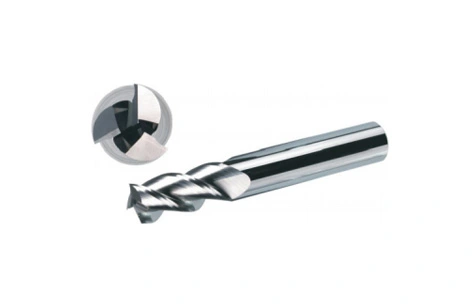
A solid carbide endmill with a square tip produces a true 90° corner at the bottom of a slot.
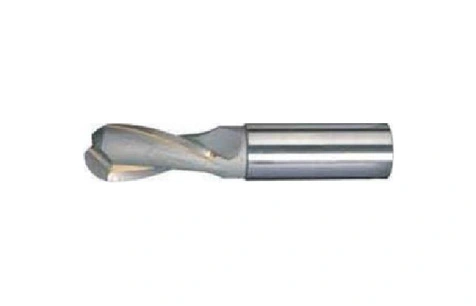
A ball nose version produces a radius floor.
Ball geometry is available both as solid tools and as ball nose insert cutter systems, where replaceable ball nose insert tips are mounted onto a tool body. Insert-based systems are often used in larger diameter finishing applications, while solid tools dominate in smaller, high-speed machining environments.
This geometric difference fundamentally changes how cutting forces are distributed.
One major difference between the two geometries lies at the tool center.
Center-cutting versions can plunge
Cutting speed approaches zero at the center
Strong corner edges
Predictable engagement in slotting
Square tools are often available in both spiral end mill designs and specialized configurations such as left hand spiral end mill or left hand spiral right hand cut end mill, depending on chip evacuation and application needs.
Exact center has zero surface speed
Center area tends to rub under heavy load
Finishing relies on step-over strategy
This is why ball nose tools are rarely used for aggressive slotting but are ideal for finishing complex surfaces.
According to basic milling mechanics (see Milling (machining) – Wikipedia), surface speed decreases toward the center of rotation, which directly impacts chip formation efficiency.
A square carbide end mill is typically preferred when:
Full-width slotting requires strong corners and stable chip evacuation.
Square geometry provides better load-bearing strength than a ball tip.
When a true 90° internal corner is required, only square geometry can achieve it.
Many solid carbide roughing end mills use square or modified square geometry because:
Corners resist chipping
Radial engagement is predictable
Chip evacuation is more controlled
In heavy-duty applications, some manufacturers also offer brazed carbide end mill designs for cost-effective roughing where full solid carbide is not necessary.
For plastics and softer materials, including end mills for acrylic, sharp-edged square tools reduce melting and edge smearing when feed rates and chip evacuation are properly controlled.
A ball nose solid carbide end mill is preferred for:
Molds, dies, turbine blades, impellers.
Small step-over finishing strategies rely on ball geometry to reduce scallop height.
In hardened materials (45 HRC and above), specialized hard milling end mills often use ball geometry to control engagement angle and reduce impact load.
In electrode manufacturing, end mills for graphite are frequently ball nose geometry, particularly for fine detail finishing where surface continuity is critical.
According to high-speed machining principles, ball nose tools are widely used in finishing hardened steels due to their controlled contact geometry.
Surface finish depends on:
Tool geometry
Step-over
Feed per tooth
Tool runout
Machine rigidity
Scallop height depends on:
Tool radius
Step-over distance
Smaller step-over → lower scallop height → smoother surface.
This geometric principle is independent of brand or manufacturer.
Square tools, by contrast, produce flat floors but will leave visible cusp marks when used for 3D surface profiling.
| Aspect | Square End | Ball Nose |
| Corner Strength | High | Moderate |
| Chipping Resistance | Strong in roughing | Better in light finishing |
| Center Strength | Good (center cutting) | Weakest at center |
Ball nose tools should not be overloaded at center engagement.
In larger diameter operations, shops sometimes switch to an insert type ball nose cutter for improved cost control and easier insert replacement.
Geometry choice interacts with flute count and helix direction.
| Material | Typical Square Tool | Typical Ball Tool |
| Aluminum | 2 flute | 2 flute |
| Steel | 4 flute | 2–4 flute |
| Hardened Steel | 4 flute | 2 flute finishing |
Special configurations such as left hand spiral right hand cut end mill designs are used to push chips downward, improving surface finish on thin materials.
Helix direction affects:
Chip evacuation
Surface quality
Vibration control
End milling rarely exists in isolation.
A typical machining workflow may involve:
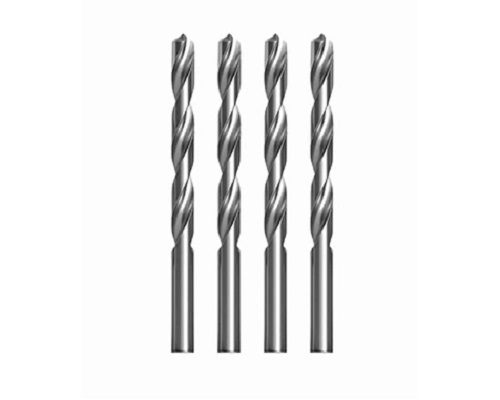
Drilling
Boring
Reaming
Milling
Understanding how tools integrate into the full system improves overall accuracy.
After drilling, finishing may require various boring tool types or a boring arbor for internal diameter control.
In precision hole finishing, a structured reamer system is often used. Some applications require advanced materials such as a ceramic reamer, especially in high-temperature alloys.
When sourcing these tools, shops often work directly with carbide reamers manufacturers to ensure dimensional consistency across tool systems.
Although this article focuses on end mills, understanding this broader machining chain ensures better tool selection decisions.
For machining process overview:
https://en.wikipedia.org/wiki/Computer-aided_manufacturing
Tool life depends on:
Substrate quality
Coating selection
Engagement strategy
Coolant control
Machine stability
A high-quality solid carbide end mill cutter performs best when cutting parameters are optimized for material type and engagement conditions.
No universal tool life value exists — performance depends entirely on application variables.
Leads to excessive center wear.
Produces visible cusp marks.
A small radius significantly improves edge strength.
Many carbide end mill manufacturers now offer square, corner radius, and ball configurations to balance performance needs.
| Application | Recommended Geometry |
| Full slotting | Square |
| Pocket roughing | Square |
| High-speed finishing | Ball nose |
| Mold cavity finishing | Ball nose |
| Sharp inside corner | Square |
| Surface blending | Ball nose |
Only if it is center-cutting. However, plunging is not ideal due to zero cutting speed at the center.
At the corners, yes. Square tools generally distribute cutting forces more evenly in roughing operations.
A ball nose insert cutter uses replaceable inserts. A solid carbide tool integrates the geometry into one piece. Insert systems are typically used for larger diameters or heavy finishing.
Yes. A left hand spiral end mill may improve chip control in specific applications, especially in thin-wall or surface-sensitive parts.
If your primary operation is:
Structural milling
Slotting
Shoulder cutting
→ Choose a square carbide milling cutter.
If your focus is:
Mold and die finishing
3D surface contouring
High-precision curved geometry
→ Choose a ball nose solid carbide end mill.
In real-world production, both geometries are often used sequentially:
Square for roughing → Ball nose for finishing.
Understanding the entire machining chain — from drilling and boring to reaming and milling — allows better overall tool strategy selection.
Milling (machining) – Wikipedia
https://en.wikipedia.org/wiki/Milling_(machining)
High-speed machining – Wikipedia
https://en.wikipedia.org/wiki/High-speed_machining
Surface roughness – Wikipedia
https://en.wikipedia.org/wiki/Surface_roughness
Computer-aided manufacturing – Wikipedia
https://en.wikipedia.org/wiki/Computer-aided_manufacturing